 WEB TESTING
 Data Integrity Testing

What is Data Integrity Testing?
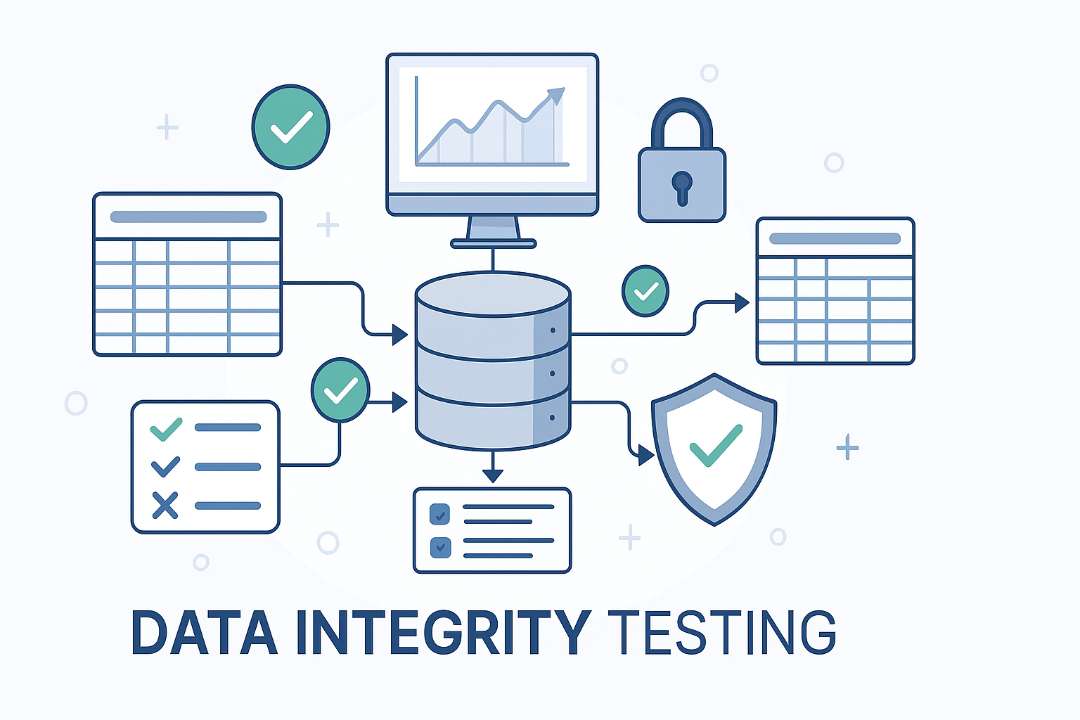
Data integrity testing is the process of verifying the accuracy, consistency, and reliability of data stored in databases, data warehouses, and other storage systems. It ensures that data is not corrupted, lost, or incorrectly modified during its lifecycle, which includes storage, retrieval, and processing. By conducting these tests, organizations can confirm that their data is complete and of high quality, which is crucial for making sound business decisions and improving operational efficiency.
The core purpose of data integrity testing is to ensure that the data remains trustworthy and fit for its intended use. This involves a series of checks and validations to uncover errors, inconsistencies, and deviations from predefined rules and standards. Essentially, it is a form of quality control for your data, guaranteeing that this critical asset is correct, secure, and appropriate for business analytics.
The Distinction Between Data Integrity, Data Quality, and Data Security
While often used interchangeably, data integrity, data quality, and data security are distinct concepts that collectively contribute to robust data management.
- Data Integrity is the overarching principle that focuses on the accuracy and consistency of data throughout its lifecycle. It involves implementing rules and standards to prevent unauthorized alterations to the data.
- Data Quality is a subset of data integrity. It measures how well a dataset meets specific requirements, considering factors like age, relevance, and completeness. Data quality processes govern data entry, storage, and transformation to maintain high standards.
- Data Security is concerned with protecting data from unauthorized access, breaches, and other malicious activities. It employs technologies and policies to safeguard data and ensure confidentiality.
In essence, data integrity encompasses both data quality and data security, creating a comprehensive framework for managing and protecting organizational data.
The Paramount Importance of Data Integrity Testing
The significance of data integrity testing cannot be overstated in today's data-driven landscape. Organizations across all sectors rely on accurate data for strategic decision-making, operational efficiency, and regulatory compliance. Failure to maintain data integrity can have far-reaching and detrimental consequences.
Core Objectives of Data Integrity Testing
The primary goals of implementing a robust data integrity testing strategy are threefold:
- Ensuring Data Accuracy: This involves validating that the data correctly represents real-world entities and conforms to expected formats, ranges, and types. Accurate data is the bedrock of reliable analytics and informed decision-making.
- Maintaining Data Consistency: Data consistency ensures uniformity of data across different systems or within a single system. Testing for consistency verifies that updates, insertions, and deletions are propagated correctly and adhere to predefined rules.
- Safeguarding Data Reliability: Data reliability refers to the ability of a system to provide accurate and complete data whenever needed. Integrity testing helps ensure that data remains uncorrupted and accessible throughout its lifecycle.
The High Cost of Neglecting Data Integrity
The repercussions of poor data integrity can be severe and multifaceted:
- Financial Losses: Inaccurate data can lead to incorrect invoicing, duplicate transactions, and mismanagement of inventory, resulting in substantial financial losses.
- Erosion of Customer Trust: Data corruption can manifest as incorrect customer account balances, misplaced orders, or erroneous credit ratings, severely damaging customer confidence.
- Compliance Violations: Many industries, such as healthcare and finance, are subject to strict data protection regulations like HIPAA and GDPR. Failure to maintain data integrity can lead to hefty penalties and legal repercussions.
- Flawed Business Intelligence: The effectiveness of business intelligence and analytics hinges on the quality of the underlying data. Decisions based on faulty data can lead to misguided strategies and missed opportunities.
- Cybersecurity Vulnerabilities: Corrupted or manipulated data can create security loopholes, making the system susceptible to fraud, hacking, and data breaches.
Key Types of Data Integrity
Data integrity is broadly categorized into physical and logical integrity. These are further broken down into more specific types that are addressed during testing.
Physical vs. Logical Integrity
- Physical Integrity: This pertains to the protection of data's accuracy and completeness during storage and retrieval. Threats to physical integrity include hardware failures, power outages, and natural disasters. Physical integrity tests, such as disk integrity checks, focus on detecting physical errors and corruption in the hardware and IT infrastructure.
- Logical Integrity: This ensures that data remains correct and consistent when used in different contexts within a relational database. It protects data from human error and hacking. Logical integrity is further divided into four main types: entity, referential, domain, and user-defined integrity.
The Four Pillars of Logical Integrity
- Entity Integrity: This principle ensures that each row in a database table is uniquely identifiable. It is achieved through the use of a primary key, which cannot have a null value. Entity integrity testing involves verifying that primary keys are unique and not null, preventing duplicate records.
- Referential Integrity: This maintains consistency between related tables. It ensures that a foreign key in one table always references a valid primary key in another table. Referential integrity testing verifies these relationships, preventing "orphaned" records that have no corresponding entry in the primary table.
- Domain Integrity: This enforces the validity of data entries within a specific column. It defines the acceptable format, type, and range of values for each data field. For example, a "date" column should only accept valid date formats. Domain integrity testing checks that data conforms to these predefined constraints.
- User-Defined Integrity: This involves enforcing rules that are specific to a particular business's needs and are not covered by the other integrity types. These are custom business rules that are implemented to ensure data accuracy and consistency according to organizational requirements.
A Structured Approach: The Data Integrity Testing Process
A systematic and well-defined process is essential for effective data integrity testing. This process typically involves a series of sequential steps to ensure comprehensive validation.
Step 1: Data Validation
This is the foundational step in data integrity testing, where individual data values are checked for correctness and adherence to predefined formats. It involves several techniques:
- Field-Level Validation: Checks if the data in a specific field conforms to the expected data type, length, and format.
- Record-Level Validation: Ensures that a complete record is logically consistent and adheres to business rules.
- Referential Integrity Checks: Verifies that the relationships between tables are maintained correctly.
Step 2: Data Consistency Checks
Once individual data points are validated, the next step is to ensure consistency across the entire dataset and between different systems. This involves:
- Cross-System Consistency Checks: Comparing data across different platforms to ensure uniformity and that it is up-to-date.
- Cross-Table Consistency Checks: Verifying that data within the same system is consistent across different tables.
Step 3: Data Anomaly Detection
This step focuses on identifying unusual or unexpected data points that could indicate an integrity issue. Common techniques include:
- Duplicate Detection: Identifying and removing redundant records.
- Outlier Detection: Finding data points that deviate significantly from the rest of the data.
Step 4: Continuous Data Integrity Monitoring
Data integrity is not a one-time task but an ongoing process that requires continuous monitoring. This final step involves:
- Periodic Data Audits: Regularly scheduled reviews of the data to ensure ongoing accuracy and compliance.
- Automated Data Integrity Checks: Implementing automated scripts and tools to regularly test the health of the data.
- Real-Time Data Validation: Continuously checking data as it is entered, processed, and retrieved to catch issues as they occur.
Common Challenges in Data Integrity Testing and How to Overcome Them
Organizations often face several hurdles when implementing a data integrity testing strategy. Recognizing these challenges and adopting proactive solutions is key to success.
Challenge | Description | Solution |
|---|---|---|
Human Error | Manual data entry and processes are prone to mistakes, which can compromise data accuracy. | Implement automation for repetitive tasks and enforce strict data entry validation rules to minimize manual errors. |
Complex Data Structures | Intricate relationships between data can make it difficult to ensure referential and domain integrity. | Utilize advanced data profiling tools to understand the data structure and prioritize testing for critical data elements. |
Large Data Volumes | The sheer volume of data can make comprehensive testing a time-consuming and resource-intensive process. | Employ scalable, cloud-based testing environments and parallel processing techniques to efficiently handle large datasets. |
Data Silos | Data stored in isolated systems can lead to inconsistencies and prevent a holistic view of the information. | Implement data integration tools to merge siloed data into a unified format, enabling comprehensive and consistent testing. |
Unauthorized Access | Unauthorized modifications to data can corrupt information and violate integrity. | Enforce strict access controls and role-based permissions to ensure that only authorized personnel can modify sensitive data. |
Inconsistent Validation Rules | Discrepancies in validation rules across different systems can lead to data errors and inconsistencies. | Establish clear and standardized data governance policies that define uniform validation rules across the organization. |
Best Practices for Robust Data Integrity Testing
Adhering to a set of best practices can significantly enhance the effectiveness of your data integrity testing efforts and foster a culture of data quality within your organization.
Establish Clear Data Governance Policies
A strong data governance framework provides the foundation for data integrity. This involves defining clear rules, roles, and responsibilities for data management, ensuring that everyone in the organization understands their role in maintaining data quality.
Automate Integrity Checks
Automation is crucial for reducing human error and enabling frequent and consistent validation, especially for large datasets. Automated tools can efficiently compare data across systems and tables, helping to maintain consistency and prevent anomalies.
Enforce Rigorous Data Validation Techniques
Implementing comprehensive data validation at the point of entry is a proactive approach to preventing bad data from entering your systems. This includes field-level validation, record-level validation, and referential integrity checks.
Implement Continuous Monitoring
Data integrity is an ongoing process, not a one-time project. Continuous monitoring, including regular audits and real-time checks, helps to detect and resolve potential issues before they escalate, ensuring that your data remains trustworthy over time.
Utilize Data Observability Tools
Modern data observability platforms provide real-time monitoring and alerts for data issues. These tools offer insights into data quality, consistency, and accuracy, enabling proactive identification and resolution of integrity problems.
Secure Your Data Through Access Controls
Limiting data access based on user roles and responsibilities is a critical step in preventing unauthorized modifications. Implementing strong authentication methods and role-based permissions helps to safeguard the integrity of your data.
Essential Tools for Data Integrity Testing
A variety of tools are available to assist organizations in their data integrity testing efforts, ranging from comprehensive data management platforms to specialized data quality and validation tools.
Data Integration and ETL Platforms
- Airbyte: An AI-powered data integration platform with a vast library of connectors that helps maintain data integrity while processing high volumes of data from multiple sources.
- Talend Data Fabric: A comprehensive suite for managing data quality, providing features for data profiling, cleansing, and validation across various systems.
Master Data Management (MDM) Solutions
- Informatica MDM: An AI-enabled tool that creates a single, authoritative view of critical business data, resolving inconsistencies and redundancies from scattered sources.
- SAS Data Management: A platform that offers robust tools for data access, preparation, and governance, ensuring data integrity throughout its lifecycle.
Open-Source and SQL-Based Tools
- dbt Core: A free, open-source tool that allows for SQL-based data transformation and testing directly within a data warehouse, promoting reliable and version-controlled transformations.
- Soda: A data quality platform that combines SQL-based testing with continuous monitoring and anomaly detection, available as both an open-source tool and a cloud platform.
Data Validation and Integrity Checking Tools
- Quickhash: A free, open-source tool for computing and verifying file hashes to ensure data integrity in digital archives.
- ClamAV+: An open-source anti-virus tool that also monitors file integrity, particularly useful for email scanning on mail gateways.
Conclusion: The Bedrock of Data-Driven Success
In the digital age, data integrity is not just a technical concern; it is the bedrock upon which successful, data-driven organizations are built. A comprehensive data integrity testing strategy is essential for ensuring the accuracy, consistency, and reliability of your most valuable asset. By understanding the core principles of data integrity, implementing a structured testing process, and adhering to best practices, organizations can mitigate risks, enhance decision-making, and build a lasting foundation of trust in their data. The journey to impeccable data integrity is a continuous one, but the rewards—in terms of improved business outcomes, regulatory compliance, and customer confidence—are immeasurable.