 WEB TESTING
 Manual Testing's Advantages and Disadvantages

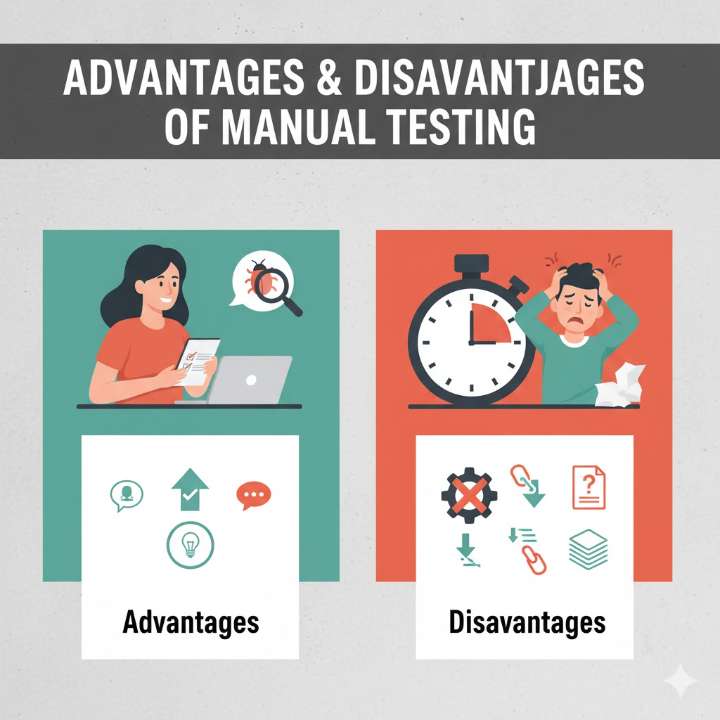
While the technological world increasingly leans towards automation, understanding the inherent strengths and weaknesses of manual testing remains crucial for any effective QA strategy. This article will thoroughly examine the advantages and disadvantages of manual testing, providing a balanced perspective on its indispensable role and outlining scenarios where it proves most beneficial. Ultimately, it seeks to demonstrate that while manual testing offers unparalleled human insight and flexibility, it also presents challenges related to efficiency, scalability, and human error, necessitating a balanced approach in the software development lifecycle.
What is Manual Testing? A Foundational Understanding
Manual testing is a type of software testing where human testers interact directly with the software application, performing operations, checking features, and validating functionality as an end-user would. Unlike automated testing, which relies on pre-scripted tests executed by software tools, manual testing involves a hands-on approach. Testers meticulously follow test plans and test cases to ensure the software meets specified requirements and performs as expected.
This method is integral at various stages of the Software Development Life Cycle (SDLC), often being the initial point of quality assessment for new features or complex user interfaces. Key characteristics of manual testing include its human-centric nature, allowing for intuitive exploration; its flexibility, enabling testers to adapt strategies as software evolves; and its responsiveness, facilitating quick identification of bugs in early development stages.
The Advantages of Manual Testing: Leveraging Human Capabilities
Manual testing offers a distinct set of advantages primarily due to the involvement of human intelligence, intuition, and adaptability. These benefits often address aspects of software quality that automated tools struggle to capture.
Unmatched Human Judgment and Intuition
One of the most significant strengths of manual testing is the ability of human testers to apply judgment and intuition. Automated scripts follow predefined rules, but a human can perceive and react to unexpected behaviors, subtle design flaws, or nuanced user experience issues that fall outside scripted parameters. This makes manual testing particularly effective for:
- Detecting Subtle Issues and Nuances: Testers can notice inconsistencies, aesthetic problems, or minor glitches that an automated script might overlook because they don't trigger a predefined failure condition.
- Exploratory and Ad-hoc Testing: In exploratory testing, testers spontaneously explore the application without pre-written test cases, using their experience and creativity to uncover defects. Similarly, ad-hoc testing involves informal, unscripted testing, relying entirely on the tester's skill and understanding. Both are powerful for discovering critical bugs in uncharted territories.
- Emulating Real User Experience and Usability Testing: Humans are inherently better at simulating real-world user behavior. They can assess whether an application is user-friendly, intuitive, and meets user expectations. This is crucial for usability testing, where subjective feedback on ease of use, navigation, and overall user satisfaction is vital.
- Assessing Aesthetics and Visual Design: Automated tools can check if an element is present or correctly positioned, but they cannot effectively judge visual appeal, alignment, color schemes, or overall design coherence. Manual testers can identify visual bugs, inconsistent layouts, or poor graphic design elements that negatively impact user perception.
High Flexibility and Adaptability
Manual testing provides unparalleled flexibility, which is invaluable in dynamic development environments.
- Responding to Evolving Requirements and Dynamic Projects: In agile methodologies or projects with frequently changing requirements, manual testers can quickly adapt their approach without the need to rewrite complex automation scripts. This agility allows teams to keep pace with rapid development cycles.
- Adjusting Test Scenarios on the Fly: As new issues are discovered or features are modified, manual testers can immediately adjust their test strategy, exploring new paths or retesting specific areas without extensive re-configuration.
Cost-Effectiveness for Specific Scenarios
While often perceived as expensive in the long run, manual testing can be remarkably cost-effective under specific conditions.
- Small-Scale Projects and Startups: For smaller applications with limited features or startups operating on tight budgets, manual testing can be more economical. It avoids the significant upfront investment in automation tools, licenses, and framework setup.
- Projects with Frequently Changing UIs or Short Lifecycles: If an application's user interface is expected to change frequently, or the project has a short lifespan, investing in automation might not yield sufficient returns. Manual testing offers a quicker, less resource-intensive initial setup.
- Lower Initial Investment Compared to Automation Setup: Manual testing requires no complex tools or frameworks to set up, making it easier for small teams or early-stage projects to commence testing without delays.
Broader Test Case Diversity
Manual testers possess the unique ability to go beyond predefined scripts, leading to more comprehensive testing in certain areas.
- Ability to Design Diverse Test Cases, Boundary Conditions, and Negative Scenarios: Testers can use their creativity and domain knowledge to devise a wider array of test cases, including edge cases, unusual inputs, and negative scenarios that might be difficult to anticipate or automate.
- Identifying Defects Missed by Automated Tests: Due to their explorative nature and human judgment, manual testers are often successful in uncovering bugs that automated tests, constrained by their scripts, might fail to detect.
Immediate Feedback and Collaboration
The direct interaction inherent in manual testing facilitates rapid communication and feedback loops.
- Direct Interaction and Quick Bug Reporting: Testers can immediately assess the impact of changes or bug fixes and provide direct, contextual insights to developers, streamlining the defect resolution process.
- Facilitating Communication Between Testers and Developers: Manual testing fosters closer collaboration. Testers can verbally explain issues, demonstrate steps to reproduce bugs, and discuss potential solutions directly with developers, leading to a more integrated development process.
Accessibility and Ease of Implementation
Manual testing often has a lower barrier to entry compared to test automation.
- Requires Less Specialized Technical Skills/Programming: Manual testing does not typically require testers to have extensive programming knowledge or familiarity with complex scripting languages, making it accessible to a broader talent pool.
- Faster Setup Time: Without the need for automation framework configuration or script development, manual testing can begin almost immediately, saving initial setup time.
The Disadvantages of Manual Testing: Inherent Challenges
Despite its clear advantages, manual testing is not without its limitations. These drawbacks primarily revolve around efficiency, scalability, and the intrinsic nature of human involvement.
Time-Consuming and Resource-Intensive
The human element that provides advantages also introduces significant time and resource considerations.
- Slower Execution, Especially for Large or Complex Applications: Manual execution of test cases is inherently slower than automated execution. For large applications with numerous features and extensive test suites, manual testing can become a bottleneck, prolonging the testing cycle and overall development timeline.
- Significant Human Effort Required: Each test scenario demands direct human intervention. This translates to substantial person-hours, especially for comprehensive testing efforts, diverting valuable human resources that could be allocated to more strategic tasks.
High Potential for Human Error
The involvement of humans, while beneficial for intuition, also introduces the possibility of errors.
- Varying Attention Levels, Fatigue, and Inconsistency: Testers are susceptible to fatigue, distraction, or simply overlooking details, particularly during repetitive or lengthy testing sessions. This can lead to missed defects or inconsistent test execution.
- Difficulty in Replicating Exact Steps Consistently: While humans can adapt, precisely replicating the same sequence of actions and inputs repeatedly, especially for regression testing, can be challenging and prone to slight variations that might affect results.
Scalability Limitations
Scaling manual testing efforts for growing projects presents significant difficulties.
- Poor Efficiency for Repetitive Tasks and Regression Testing: Repeatedly executing the same test cases, such as in regression testing (ensuring new changes haven't broken existing functionality), is tedious and inefficient when done manually. Automated tests excel here, running thousands of tests in minutes.
- Challenges with Large Volumes of Data and Extensive Test Cases: For applications dealing with vast amounts of data or requiring verification across numerous permutations, manual testing becomes impractical. Covering all possible scenarios manually would be extraordinarily time-consuming, if not impossible.
- Difficulty in Achieving Comprehensive Test Coverage for Vast Systems: Due to time and resource constraints, manual testing often leads to lower test coverage for extensive applications, increasing the risk of undetected defects in overlooked areas.
Long-Term Cost Implications
While initially cost-effective, manual testing can become more expensive over the long term for larger projects.
- High Labor Costs for Sustained, Large-Scale Projects: As projects grow in complexity and duration, the cumulative cost of hiring and retaining a large team of manual testers can surpass the initial investment of automation.
- Training and Retention Challenges for Skilled Manual Testers: Attracting, training, and retaining skilled manual testers in a competitive QA market can be challenging, contributing to overall operational costs.
Lack of Reusability and Maintainability
Manual test assets often have limited longevity and require constant updates.
- Test Cases Often Become Outdated with Software Updates: When the software undergoes updates or new versions are released, existing manual test cases may become obsolete or require significant modifications, leading to rework.
- Need for Constant Rewriting: This lack of reusability means that test cases frequently need to be rewritten or heavily revised, which is a drain on resources and time.
Subjectivity and Inconsistency in Reporting
The human element can introduce subjective interpretations into the testing process and reporting.
- Test Outcomes Can Be Influenced by Individual Tester's Interpretation: Different testers might interpret requirements or observe behavior slightly differently, leading to varied results or inconsistent bug reports.
- Less Objective Data Compared to Automated Metrics: Manual testing often relies on qualitative observations, whereas automated tests provide objective, quantifiable metrics on pass/fail rates and performance data, which can be easier to analyze and track over time.
When to Opt for Manual Testing: Strategic Application
Understanding the strengths and weaknesses of manual testing allows for its strategic application in scenarios where its advantages are most pronounced.
- Exploratory Testing: Ideal for gaining a deep understanding of the application, discovering hidden defects, and improving test case design for future automation.
- Usability and User Experience (UX) Testing: Essential for evaluating how user-friendly, intuitive, and aesthetically pleasing an application is, directly from a human perspective.
- Ad-hoc Testing: Useful for quick checks and informal exploration, particularly when there's insufficient time for formal test case design.
- User Acceptance Testing (UAT): Crucial for verifying that the software meets the end-users' needs and business requirements in a real-world context before deployment.
- New Feature Testing (Early Stages): When new features are introduced, and the user interface or functionality is rapidly evolving, manual testing provides immediate feedback and flexibility without the overhead of constant script updates.
- Small, Short-Term Projects with Limited Budgets: For projects where the cost of setting up automation outweighs the benefits, manual testing offers a practical and economical solution.
- Complex Scenarios Requiring Human Judgment: This includes testing visual aspects, complex gesture-based interactions, or any scenario where human interpretation is irreplaceable.
Bridging the Gap: Manual Testing in a Hybrid QA Strategy
In today's fast-paced development landscape, the most effective QA strategies rarely rely solely on one testing method. Instead, a hybrid approach, strategically combining manual and automated testing, typically yields the best results.
- The Complementary Relationship with Automated Testing: Automated testing excels at speed, repeatability, and handling large volumes of regression tests and data-driven checks. Manual testing complements this by bringing human intuition, exploratory prowess, and a focus on user experience. Automated tests ensure the system functions correctly, while manual tests ensure it feels right to the user.
- Best Practices for Integrating Both Approaches: Teams should identify repetitive, high-volume, and stable test cases for automation. Complex, subjective, and infrequently changing test cases, along with exploratory and usability testing, should be reserved for manual execution. This ensures optimal resource allocation and comprehensive coverage.
- Maximizing Efficiency and Coverage: By leveraging the strengths of both methods, organizations can achieve a higher level of software quality, faster time-to-market, and greater confidence in their product. Automated tests provide a safety net for core functionalities, while manual tests ensure a superior user experience and uncover nuanced defects.
Conclusion
Manual testing, a cornerstone of software quality assurance, presents a unique blend of advantages and disadvantages. Its ability to harness human judgment, intuition, and adaptability makes it indispensable for tasks requiring subjective evaluation, such as usability testing, exploratory testing, and assessing visual aesthetics. It offers unparalleled flexibility in dynamic development environments and can be a cost-effective solution for small-scale or early-stage projects.
However, the inherent human element also brings challenges. Manual testing can be time-consuming, prone to human error, and difficult to scale for large, complex, or highly repetitive tasks like extensive regression testing. It also entails long-term labor costs and issues with test case reusability.
Ultimately, manual testing remains an indispensable component of a robust QA strategy. Its limitations are best addressed not by abandonment, but by strategic integration with automated testing. By understanding when and where to apply manual testing, organizations can craft a balanced and highly effective quality assurance process, ensuring the delivery of high-quality, user-centric software applications. This strategic application of both manual and automated approaches is key to achieving optimal software quality in the modern development landscape.