 CASE STUDY
 Load vs. Stress Testing -- No More Mix-Ups!

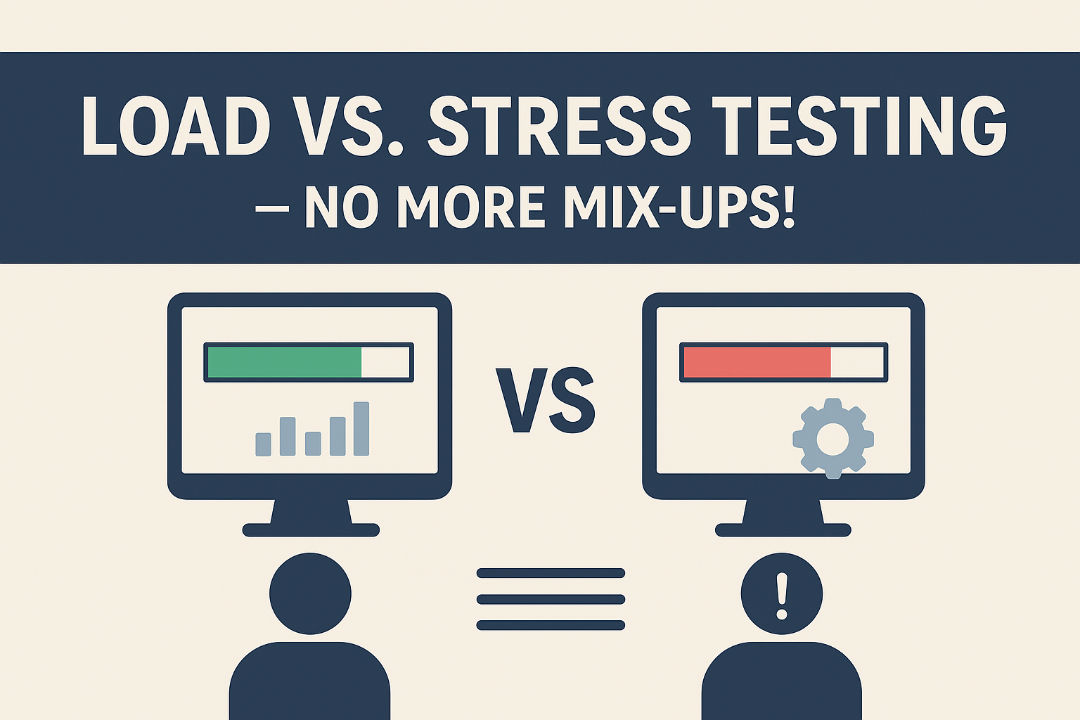
Load testing and stress testing are both types of performance testing. However, many people often confuse them — and I’ve faced the same issue myself when someone asked me about their key differences. So, I searched online to find a clear distinction that removes any confusion.
What is Load Testing?
Load testing is a performance testing technique used to check how a system behaves under a specific, expected workload.
What is Stress Testing?
Stress testing is a performance testing technique used to check how a system behaves beyond its expected workload, often until it fails.
Let's clear it with an example: Simulating 1,000 concurrent users on an e-commerce site to confirm it still loads pages within acceptable time. If it is able to work properly then no issue. Then let's increase the user number to 1001 and Boom! the system breaks. So let's break down this:
Step 1 — 1,000 concurrent users
- This matches your expected workload during peak hours.
- You measure page load time, checkout speed, and error rates.
- If the site performs well here, it passes the load test.
✅ This is load testing.
Step 2 — Increase to 1,001 users (and beyond)
- This is beyond your expected workload.
- You keep increasing the number until the site slows down, throws errors, or crashes — in this example, at 1,001 users.
- The point where it fails is its breaking point.
✅ This is stress testing.
In summary,
Load testing answers: “Can it handle what we expect?”
Stress testing answers: “What happens when we push it past the limit?”
Tools used for both load and stress testing:
- Apache JMeter : Open-source, Java-based
Uses: GUI-based, large community, supports distributed testing
- Locust: Open-source, Python-based
Uses: Highly customizable, great for complex workflows, scalable
- k6: Open-source, script-based (JavaScript)
Uses: Lightweight, developer-friendly, good cloud options
- Gatling: Open-source + enterprise version (Scala-based)
Uses: Detailed reports, good for DevOps pipelines
- Artillery: Open-source, JavaScript-based
Uses: Simple scripting, good for quick tests, integrates with CI/CD
- BlazeMeter: Cloud-based (built on JMeter)
Uses: Scales globally, no need to maintain infrastructure
💡 Note: The tool doesn’t decide whether it’s load testing or stress testing — it’s how you configure it that makes the difference.